
DIE YOUNG?
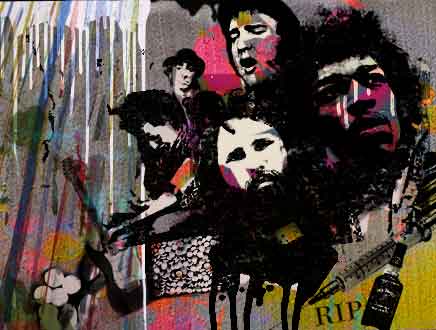
For Famous Rockers, More Sex, Drugs — And Death?
By Jacob Wittich
 EVERYBODY KNOWS THAT SEX GOES WITH DRUGS AND ROCK ‘N ROLL. BUT SO DOES DEATH, ACCORDING TO MARK BELLIS, Director of The Centre for Public Health at Liverpool John Moores University.
A study by Bellis and fellow researchers concluded that famous rock and pop stars are more likely to die at a younger age than the general public, and solo musicians are more likely to die young than members of a band.
We’re all familiar with the anecdotal’s evidence of the claim: Amy Winehouse, Michael Jackson, Whitney Houston, Elvis Presley, Jim Hendrix, Kurt Cobain, Janis Joplin, Hillel Slovak, Gram Parsons, Brian Jones, Ian Curtis, Sid Vicious, Notorious B.I.G.,Tupac Shakur — these are just a few of the famous musicians who tragically died too young.
The British study looked at 1,489 rock and pop stars popular between 1956 and 2006 and found that musicians were more likely to die from substance abuse if they faced childhood adversity.
Forty-seven percent of rock and pop stars who died of “risk-related causes” –- such as drug abuse, suicide or violence — had endured some form of childhood adversity, according to the study published in the British journal, BMJ Open. Among famous rockers who died prematurely, 25 percent died from “other causes.”
Bellis and his team concluded the findings demonstrate a direct link between childhood adversity and “high risk behaviors.”
Interestingly, American musicians had a higher incidence of premature death compared to their European peers, with 23 percent of American solo stars dying prematurely versus 9.8 percent for European solo stars, Pacific Standard reported.
The study’s authors believe their findings could dissuade youth from emulating the rock idols whose drug use gets glamorized in the media. If the general public understands that drug use isn’t a byproduct of fame but rather caused by deep-rooted childhood adversity, celebrity worshippers would be less inclined to glorify drugs.
“Millions of youths wish to emulate their icons,” says Bellis of the phenomenon. “It is important they recognize that substance use and risk-taking may be rooted in childhood adversity rather than seeing them as symbols of success.”
Bellis contends that while fame may provide famous musicians’ easier access to drugs, the true cause of their risky behavior is a troubled childhood.
Researcher hope the study provides a counterweight to today’s celebrity worship. “A better understanding of the underlying causes of risk-taking in performers may help deglamorize such behavior, and reduce its appeal to fans and would-be rock and pop stars,” Bellis concludes
Something to think about as you’re watching Ke$ha’s party-pushing song, Die Young.
Jacob Wittich is pop music fanatic majoring in journalism at Columbia College Chicago.